

Emotional Quotient For Men

What Emotional Quotient Means and Why It Matters for Men
“Know Yourself • Connect Authentically • Build Confidence”
Most people have heard of IQ, or Intelligence Quotient, but fewer understand Emotional Quotient (EQ). While IQ measures cognitive abilities such as reasoning, memory, and problem-solving, Emotional Quotient refers to a person's ability to recognize, understand, regulate, and effectively use emotions in everyday life.
For men, EQ has become one of the strongest predictors of healthy relationships, effective leadership, resilience under stress, and long-term personal success. Contrary to many outdated stereotypes, emotional strength isn't about suppressing emotions, it's about learning how to manage them wisely. Whether building a relationship, leading a family, managing employees, or simply striving to become a better version of oneself, improving EQ can have a profound impact on nearly every area of a person's life.
What Is Emotional Quotient (EQ)?
Emotional Quotient is defined as the measurable expression of a person's emotional intelligence (EI). Rather than being simply a subjective interpretation of how someone expresses emotions, EQ is an attempt to quantify a person’s emotional abilities using standardized assessments. Similar to how an Intelligence Quotient (IQ) measures aspects of cognitive ability, EQ measures how effectively a person recognizes, understands, and manages their emotions.
Researchers John Mayer and Peter Salovey originally defined emotional intelligence as a person’s ability to understand, use, and manage their emotions effectively. Later, psychologist Daniel Goleman brought the concept into mainstream through his work on leadership and workplace performance.
Here is how EQ and EI differ and how they can be measured:
Emotional Intelligence refers to the overall set of emotional skills and abilities that enable a person to recognize, understand, manage, and effectively respond to emotions in themselves and others. Like any skill, EI can be developed and strengthened over time through self-awareness, practice, and experience.
Emotional Quotient on the other hand, refers to the measurement or score of a person's EI. It is the result of an assessment designed to evaluate various aspects of emotional functioning, such as self-awareness, emotional regulation, empathy, and interpersonal skills. As a person's EI grows, their EQ will also improve.
A simple way to remember the difference is:
Intelligence Quotient → IQ
Emotional Quotient → EQ
In everyday conversation, most people commonly use the term "EQ" when referring to emotional intelligence as a whole. While there technically a difference between the two, they are commonly interchanged with their usage. Simply put, EI refers to a person's overall ability to recognize, understand, and manage emotions, while EQ is the measurement or assessment of those abilities.
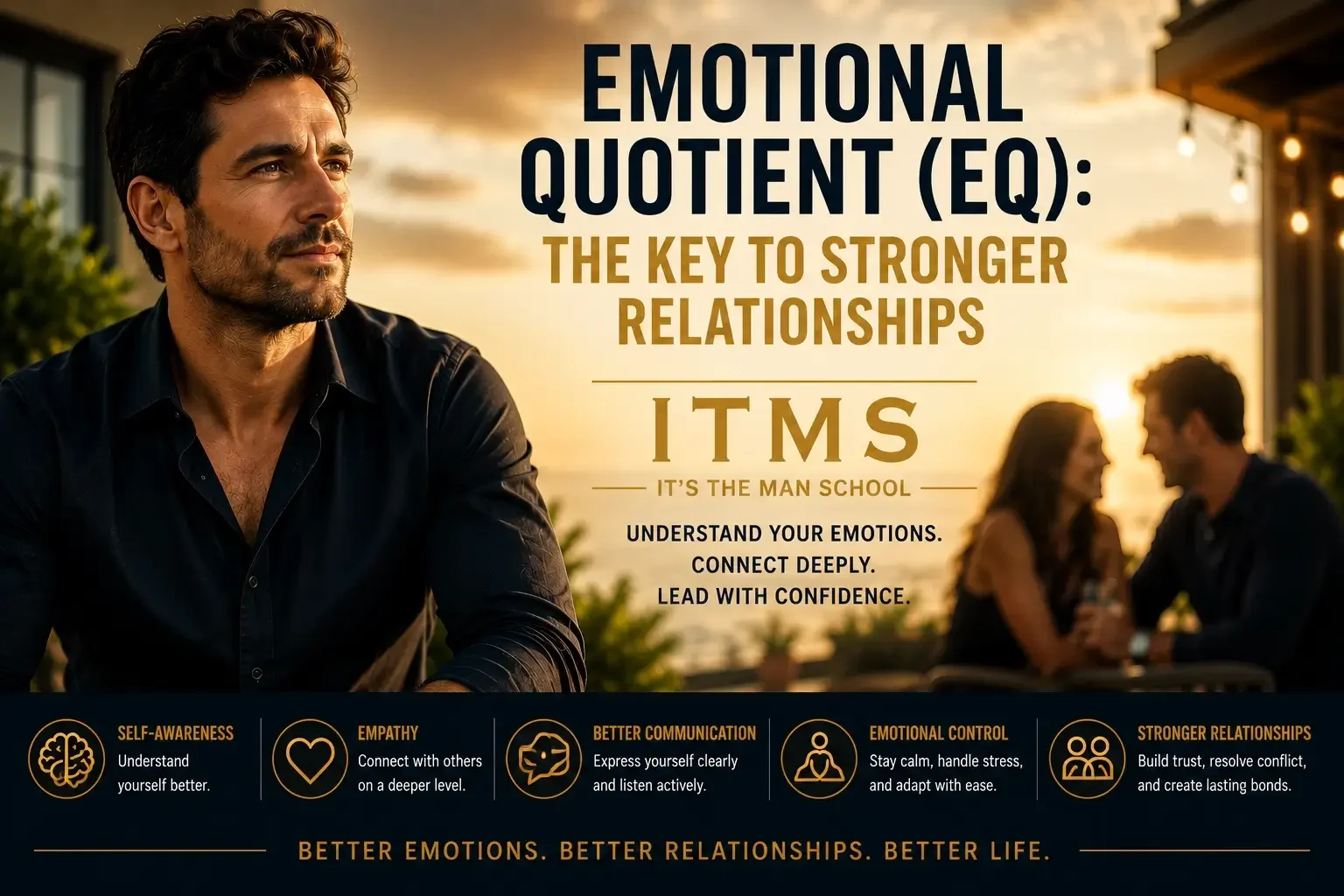
Why Emotional Quotient Matters for Men
Many boys grow up hearing messages like "Man up," "Don't cry," or "Be tough." While the intent may be to encourage strength and resilience, these phrases can also send the unintended message that certain emotions should be suppressed or ignored. The problem with this ideology is that suppressing one's emotions is not the same as being in control of them.
True emotional strength isn't about hiding one’s feelings, it's about recognizing them, understanding why they occur, and responding to them in healthy and productive ways. A man with a high EQ has developed these skills, allowing him to navigate life's challenges with confidence and self-control.
Developing emotional intelligence, which often leads to a higher EQ, doesn't make a man less masculine, it makes him more mature, self-aware, and grounded. These are qualities that many women look for in a partner because they foster trust, stability, and healthy communication.
How a Man’s EQ is Measured
Unlike traditional IQ tests, there is no single universally accepted EQ score. The attempt has been to standardize these tests and make the results objective rather than subjective.
Researchers generally measure a man’s EQ using three approaches:
Ability-Based Tests
Ability-based tests measure how well a person recognizes, understands, and responds to feelings in real-life situations. Rather than asking someone to rate their own interpersonal skills, these assessments present practical scenarios that evaluate how they interpret facial expressions, social cues, and the reactions of others. For example, participants may be asked to identify what someone is feeling based on their facial expression or choose the most appropriate response to a challenging interpersonal situation.
One of the most well-known ability-based assessments is the Mayer-Salovey-Caruso Emotional Intelligence Test (MSCEIT). This assessment is widely used by researchers, educators, and mental health professionals to better understand a person’s EI.
Self-Report Questionnaires
In contrast to ability-based tests, self-report questionnaires are among the most commonly used methods to assess a person’s EQ. Instead of evaluating how someone responds to real-life scenarios, these assessments ask participants to reflect on their own behaviors, habits, and interpersonal skills by rating statements such as:
I remain calm under pressure
I understand how other people feel
I recover quickly from setbacks
I adapt well to unexpected challenges
There are many well-established assessments use this approach, including the Emotional Quotient Inventory (EQ-i), the Trait Emotional Intelligence Questionnaire (TEIQue), and the Schutte Self-Report Emotional Intelligence Test (SSEIT). Most of these assessments ask participants to rate how strongly they agree or disagree with a series of statements using a standardized rating scale (Ex: 1–5 scale Strongly Disagree → Strongly Agree).
These responses are then analyzed to score areas of self-awareness, empathy, self-regulation, and interpersonal skills. These individual assessments are then combined into an overall EQ score, which can be used to highlight a person’s strengths and opportunities for growth.
However, it is important to note that while these questionnaires can provide valuable insights into how someone perceives themselves, they rely heavily on honest self-evaluation. As a result, the scores may not always reflect how a person actually responds in everyday situations, or how others view their behavior.
360-Degree Assessments
This approach is quite a bit different than the Self-Report Questionnaires and Ability-Based Tests, as they evaluate a person’s EQ through anonymous feedback. This assessment targets the people who interact with the person being assessed. This can include supervisors, coworkers, direct reports, friends, or family members, depending on the purpose of the assessment.
Rather than relying solely on a person's perception of themself, this approach offers a much broader and more objective view on how they communicate, handle conflict, build relationships, and respond to challenging situations. By comparing feedback from multiple sources, 360-degree assessments can offer a more balanced and objective view of how a person's EQ is demonstrated in everyday life.

"Develop the Emotional Quotient Women Find Most Attractive"
Professional Dating Coaching For the Modern Man


Can a Man’s Emotional Quotient Be Improved?
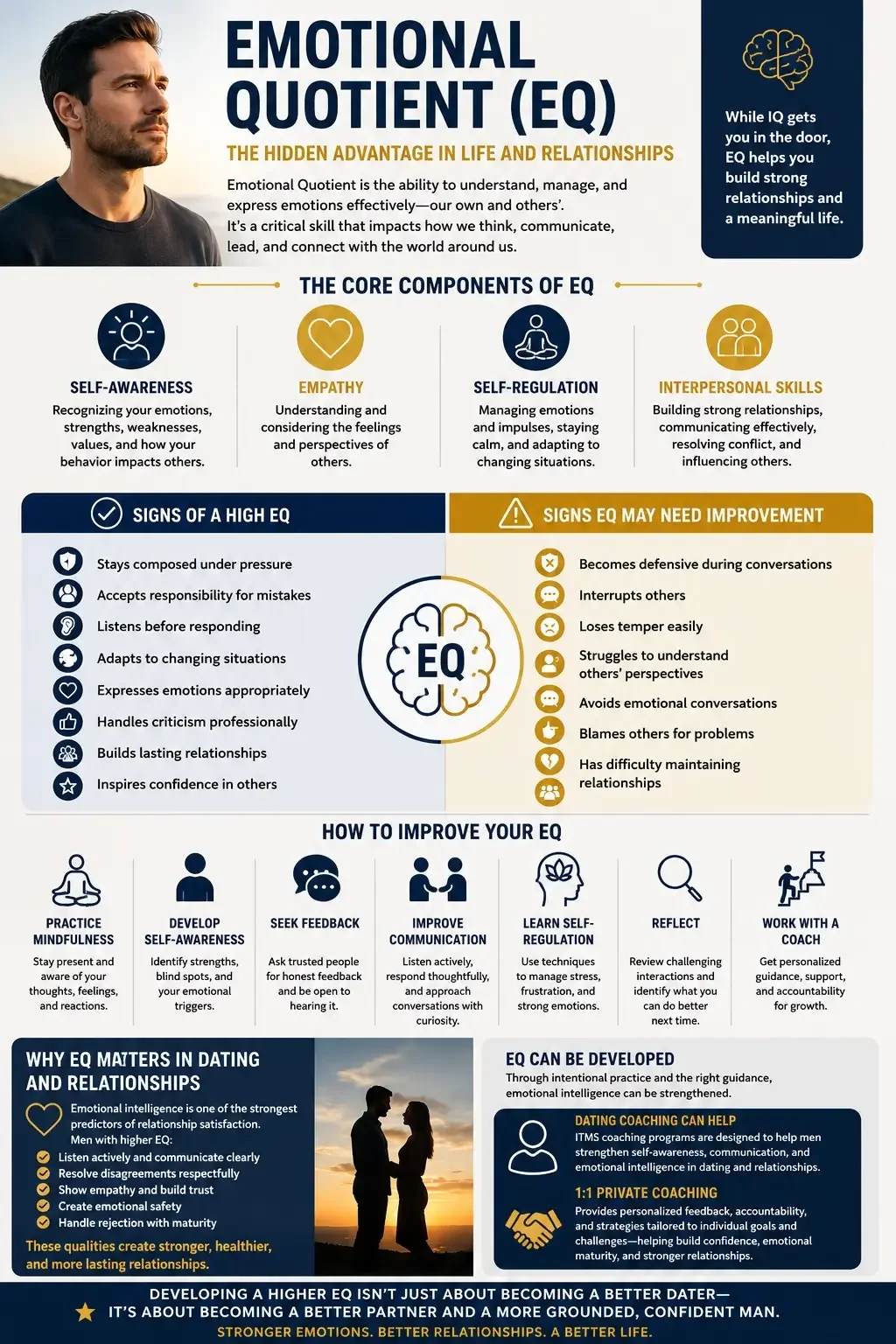
Absolutely. Unlike IQ, which tends to remain relatively stable throughout adulthood, a person’s EQ is a set of skills that can be developed over time. With intention, practice, and a willingness to learn, most men can strengthen their ability to understand themselves better, communicate more effectively, and build healthier relationships.
Research suggests that Emotional Quotient can be improved by:
Practicing mindfulness to become more aware of one’s thoughts, feelings, and reactions in the moment.
Developing greater self-awareness by recognizing personal strengths, weaknesses, and the situations that trigger certain responses.
Seeking constructive feedback from friends, mentors, or colleagues to gain insight into how a person’s behavior can affect others around them.
Improving communication skills by listening with intention, staying composed under pressure, and approaching difficult conversations with curiosity instead of becoming defensive or reactive.
Learning healthy self-regulation techniques that help you manage stress, frustration, and conflict without reacting impulsively.
Working with a coach or therapist who can provide guidance, accountability, and practical strategies for personal growth.
Reflecting on challenging interactions to identify what went well, what could have been handled differently, and how to respond more effectively in the future.
Like any meaningful skill, developing EQ takes time and consistent effort. Small, intentional changes practiced over weeks and months can lead to significant improvements in self-awareness, communication, and healthier relationships.
Signs of a Man With a High EQ
A man with a high EQ isn’t about perfection, it’s about someone who genuinely understands his thoughts and feelings, manages them well, and responds thoughtfully in challenging situations. These qualities are usually evident in the way he communicates with others, handles adversity, and builds relationships.
Men with a well-developed EQ tend to remain composed under pressure, take responsibility for their mistakes, and listen to understand rather than simply waiting for their turn to speak. They adapt well in dynamic circumstances, can accept criticism without being defensive, and express themselves respectfully with confidence. These traits not only strengthen relationships with others, but also inspire trust and credibility in both professional and social settings.
On the other hand, there are signs that a man's EQ may benefit from further development. Frequently becoming defensive during conversations, interrupting others, avoiding difficult conversations, blaming others for problems, or having difficulty maintaining healthy relationships can all indicate opportunities for growth.
When a man becomes more self-aware, and embraces a willingness to learn, these skills can be strengthened over time. Even small improvements in communication, self-regulation, and empathy can have a meaningful impact on relationships and overall quality of life.
Why Emotional Quotient Is Important in Dating
While qualities like intelligence, ambition, and physical attraction certainly play a role in dating, research consistently suggests that emotional intelligence is one of the strongest predictors of satisfaction and stability in long-term relationships. A man with a high EQ will allow him to build healthier relationships, navigate challenges more effectively, and create bonds with others founded on trust, mutual respect, and genuine understanding.
Men with a higher EQ are often better equipped to:
Listen actively and seek to understand before responding.
Express their thoughts and feelings clearly without becoming overwhelmed or shutting down.
Resolve disagreements respectfully by focusing on solutions rather than winning arguments.
Demonstrate empathy by understanding and validating another person's perspective.
Create a sense of trust and security through consistency, honesty, and emotional maturity.
Handle rejection and setbacks with confidence, viewing them as opportunities for growth rather than personal failure.
These qualities not only strengthen romantic relationships but also improve communication, reduce unnecessary conflict, and foster deeper, more meaningful connections over time.
At It's The Man School (ITMS), many of the principles taught throughout our dating coaching programs are designed to strengthen the very skills that contribute to a higher EQ. Men learn how to become more self-aware and confident, tend to have better communication skills, can handle conflicts without becoming upset, and build authentic relationships with women without sacrificing their masculinity or sense of self.
For men seeking more personalized support, ITMS's 1:1 private coaching offers individualized guidance tailored to each person’s unique dating experiences, relationship goals, and personal challenges. Working directly with an experienced coach provides honest feedback, accountability, and practical strategies that can help men develop greater confidence and develop the emotional maturity needed to create healthy, lasting relationships.
"Women Love Men Who Have a High EQ"
Expert Dating Coaching For The Modern Men

Emotional Quotient - FAQs
Can Coaching help improve someone’s emotional quotient?
Absolutely. Dating coaching provides personalized feedback, accountability, and practical strategies to help men strengthen their communication, self-awareness, confidence, and relationship-building skills through real-world application. Coaching sessions are typically conducted 1:1 and tailored to each individual's unique goals and challenges. Men who invest in personalized coaching often develop stronger relationship skills, experience greater confidence in dating, and build healthier, more fulfilling relationships over time.
Is Emotional Quotient more important than Intellectual Quotient?
Both are valuable, but they measure different abilities. IQ evaluates cognitive reasoning and problem-solving skills, where EQ focuses on communication, self-management, empathy, and relationship-building. Success in life often depends on a combination of both, while those with a high EQ often have healthier and more satisfying relationships overall.
Can someone have a high IQ but a low EQ?
Yes. Intellectual ability and interpersonal relationship skills are separate qualities. A person may excel academically or professionally while still struggling with communication, conflict resolution, or relationship management. Just because a person is highly intelligent doesn’t necessarily mean they have great people skills.
Why should men focus on developing their EI and EQ?
A person who focuses on strengthening their EI and EQ are more self-awareness, communicate better, and have healthier relationship skills that can positively influence nearly every area of one’s life, from dating and marriage to parenting, leadership, career growth, and personal well-being. As these abilities develop, so do confidence, resilience, and the ability to have healthier and more authentic connections with others.
Does Emotional Quotient improve with age?
Not necessarily. However, getting older and life experience can contribute to personal growth, but meaningful improvement usually requires self-reflection, intentional practice, and a willingness to learn from successes as well as setbacks. While it’s not automatic for a person’s EQ to improve with age, it often does for those that focus on self-improvement, and becoming the best version of themselves.
Why do women value a man with a higher EQ?
Yes, many women appreciate men who communicate clearly, handle conflict with maturity, remain calm rather than reacting impulsively, can show empathy, and create a sense of trust and emotional security within the relationship. In today's modern dating landscape, men with a higher EQ are often more likely to build healthier partnerships and experience long-lasting happiness.
Can stress have an influence on a person’s EQ?
Yes, stress can have an impact on someone’s EQ. High levels of stress and anxiety can make it more difficult to regulate reactions, think clearly, and communicate effectively. Developing healthy coping strategies can help improve decision-making and strengthen relationships during challenging situations. While everyone experiences stress at some point in life, those who have developed strong self-management skills are often better able to navigate difficult situations without becoming overwhelmed or reacting impulsively, are qualities commonly associated with a higher EQ.