

What Is Emotional Availability?

Emotional Availability Can Improve Dating Success For Men
Know Yourself • Communicate Openly • Build Deeper Connections
Dating success for men is often framed around confidence, attraction, appearance, and knowing how to make a good first impression. Those things can certainly matter. But there is another quality that becomes increasingly important when you want something deeper than simply getting someone's attention, and that’s emotional availability.
Being emotionally available doesn't mean sharing every feeling you have, becoming overly vulnerable with someone you barely know, or turning every date into a serious conversation. It essentially means being capable of recognizing your emotions, communicating what matters to you, allowing another person to get to know you without putting up walls, and remaining emotionally present when a relationship begins to deepen.
For men, this can be especially important, since many have learned how to be confident, independent, productive, and resilient without necessarily learning how to communicate what’s happening beneath the surface. A man may be successful in his career, socially confident, and perfectly capable of attracting women, yet still struggle to build and maintain relationships that last.
That’s often because healthy relationships require a different set of skills. Being open and appropriately vulnerable, showing empathy, communicating clearly, and expressing what you’re thinking and feeling can all play an important role in building trust, and an emotional connection that helps relationships grow and last. That doesn't make a man incapable of having a great relationship. It simply means there may be another set of relationship skills worth developing, and those skills can be learned.
What does it mean to be emotionally available?
Being emotionally available generally means being willing and able to engage with the emotional side of a relationship. It involves understanding what you’re feeling, communicating when something matters to you, listening to your partner, and being willing to open up as trust naturally develops.
In Dating, this Can Show Up in Everyday Situations Such as These:
Can you tell a woman you enjoyed spending time with her without worrying that showing interest makes you look weak?
Can you talk about something that’s bothering you instead of becoming distant?
Can you listen when your partner is upset without reacting defensively, or trying to fix the problem?
It can also mean being able to admit when you’re wrong, talk openly about what you want from a relationship, and gradually let someone get to know who you really are rather than presenting the version of yourself you think she wants to see.
Ultimately, it’s not just about being more emotional or sharing everything you’re feeling. It’s more about being comfortable enough with yourself to communicate openly and allow a genuine connection to develop with another person.
What Does This Look Like in Practice?
Being open emotionally doesn’t mean a man has to wear his heart on his sleeve or talk about his feelings all the time. He can be quiet or outgoing, introverted or extroverted, expressive or more reserved. It’s less about personality and more about how he communicates and responds to the people he cares about.
In a relationship, this might include:
Communicating honestly about what he wants: Being clear about his intentions, needs, and expectations rather than expecting his partner to figure them out on her own
Showing affection and appreciation: Letting his partner know that she matters through words, attention, affection, and acknowledging the things he appreciates about her
Listening without always needing to provide a solution: Understanding that sometimes a partner wants to feel heard rather than immediately being told how to fix the situation
Acknowledging difficult feelings when they come up: Being able to recognize when he’s hurt, frustrated, disappointed, worried, or upset instead of automatically ignoring or burying those feelings
Taking an interest in what his partner is thinking and feeling: Asking questions, paying attention, and making an effort to understand her perspective, even when it differs from his own
Being willing to have conversations that may be
uncomfortable: Addressing concerns, expectations, disagreements, or changes in the relationship rather than continually avoiding difficult subjects
Taking responsibility when he makes a mistake: Being able to acknowledge when he got something wrong, apologize when appropriate, and make an effort to handle things differently moving forward
Setting and respecting healthy boundaries: Being comfortable communicating his own limits while also listening to and respecting the boundaries his partner communicates
Becoming more open as trust develops: Gradually sharing more about himself, his experiences, and what matters to him as the relationship becomes closer and trust grows
Following through on what he says and being consistent in his actions: Making sure his behavior generally matches his words so his partner isn’t left guessing about his intentions or where she stands with him
It also means not automatically shutting down or pulling away whenever a conversation becomes uncomfortable. Sometimes it may take time and some space to effectively process one’s feelings, and that’s perfectly reasonable. The important part is being willing to come back to the conversation rather than continually avoiding it
No one handles every conversation perfectly all the time. The ultimate goal is being able to stay engaged, communicate honestly, and become comfortable letting another person get to know you on a deeper level.
Strength and Openness Can Coexist in Relationships
Some men may be uncomfortable with vulnerability because it can seem at odds with traditional ideas about masculinity. Men are often encouraged to be composed, independent, decisive, and resilient, and there’s nothing inherently wrong with any of those qualities.
Research into masculinity and emotional expression by Clark University suggests that men often face social expectations of keeping their emotions to themselves, which can potentially influence when and how comfortable they feel opening up to others.
The problem is when emotional control turns into emotional avoidance. There’s a difference between managing your emotions and pretending they aren’t there. Being able to say, “That bothered me, and I’d like to talk about it,” doesn’t make a man less confident. In fact, being willing to address something directly can take more confidence than avoiding the conversation altogether.
Being open with someone doesn’t mean giving up your independence or becoming overly emotional. It means being comfortable enough with yourself to communicate honestly when something matters, while still handling your emotions in a healthy way.
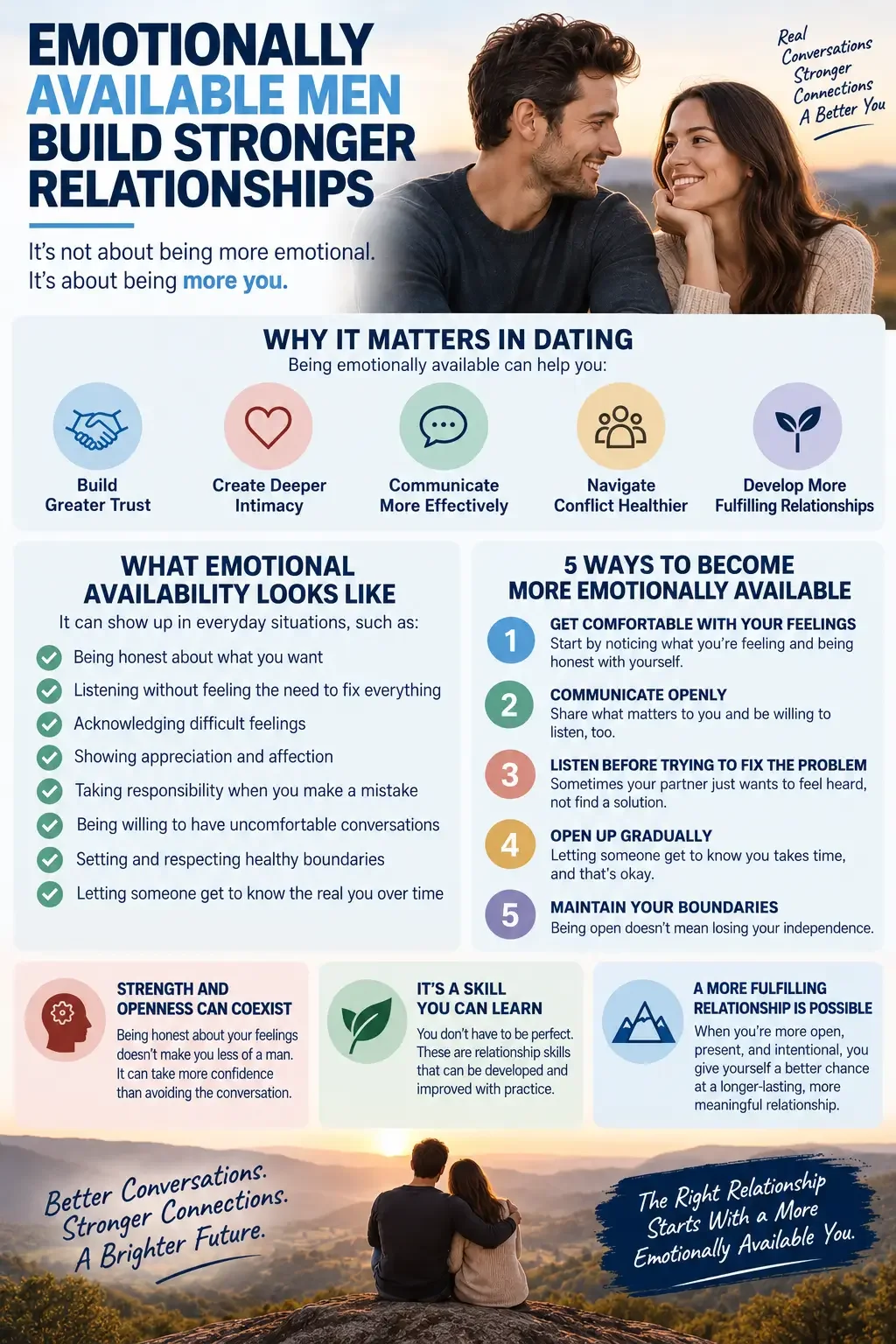
Why Emotional Availability Matters in Dating
Attraction is an important part of dating, but if you’re looking for a meaningful relationship, attraction alone usually isn’t enough. As two people get to know each other, building trust, comfort, and a stronger emotional connection becomes increasingly important. That requires gradually letting another person get to know you beyond the surface.
A man can be charming, funny, successful, attractive, and confident, yet still leave a woman feeling like something is missing. She may enjoy spending time with him and feel attracted to him, but eventually start wondering:
“I really like spending time with him, but does he actually like me the same way?”
“What is he really looking for here? Does he want a relationship, or is he just seeing where things go?”
“Why does he seem to pull away or change the subject whenever our conversations start getting more personal?”
“We spend a lot of time together, and I know what he does, what he likes, and what he’s interested in — but how well do I really know him?”
“Why do I sometimes feel close to him, and then other times feel like there’s a wall between us?”
“Is he comfortable letting me into his life, or is he intentionally keeping some distance between us?”
That uncertainty can make it very difficult for a relationship to move forward, even when two people are very attracted to each other. Chemistry may be the initial spark that brings two people together, but being willing to open up and get to know each other on a more personal level is often what gives that connection an opportunity to develop into something more meaningful.
Chemistry is Only Part of the Equation
Early dating often comes with attraction, chemistry, excitement, and the fun of getting to know someone new. But as a relationship develops, those initial feelings are only one part of what brings two people together.
Eventually, dating starts to include more of real life. You may have disagreements, one of you may be going through a difficult time, insecurities can begin to surface, and relationship expectations may need to be discussed. Physical intimacy may also change and deepen, and outside pressures from work, family, finances, and everyday life can also have an impact on the relationship.
This is where being able to communicate and understand each other becomes increasingly important. Having the ability to talk through disagreements, listen to each other’s concerns, express what you need, and stay connected during more difficult moments can help a relationship continue to grow beyond the honeymoon phase of early dating.
There’s a significant difference between having chemistry and really getting to know each other. Ideally, a healthy relationship has room for both. Chemistry may help create the initial attraction, while trust, communication, and having an emotional connection can help give the relationship a stronger foundation as it grows.
Signs You May Be Emotionally Unavailable in Dating
Being emotionally unavailable doesn’t necessarily mean you avoid talking about feelings or have no interest in a relationship. In fact, you may genuinely want a long-term meaningful relationship but find yourself pulling back when dating starts to become more serious.
Sometimes the signs are fairly subtle, and you may not even realize you’re doing it. You might recognize some of these patterns in your own dating experiences:
You tend to lose interest when someone starts getting closer to you
You avoid conversations about where the relationship is going
Being affectionate, or talking about how you feel makes you uncomfortable
Your relationships tend to remain mostly physical or casual
You shut down or withdraw when there’s a disagreement
You become defensive when she brings up something that’s bothering her
You rarely ask other people for help or emotional support
You use humor or change the subject when conversations become too personal
You repeatedly find yourself attracted to people who aren’t looking for a serious relationship
You pull back and are uncomfortable after you’ve been open or vulnerable
You know something is bothering you but you just can’t put it into words
You worry that getting too close to someone could mean giving up your independence
Recognizing one or two of these behaviors doesn’t necessarily mean you’re emotionally unavailable. Everyone pulls back, gets defensive, or has difficulty communicating from time to time, especially when the relationship is new.
What’s more helpful is looking for patterns. If you notice the same behaviors showing up repeatedly, especially when a relationship starts becoming more serious, it may be worth asking yourself what's behind them. Becoming aware of those patterns is often the first step in changing how you approach dating and relationships.
Why Opening Up Can Be Difficult
There isn’t one reason why a man may have difficulty opening up or expressing what he’s feeling. For some men, it can go back to what they learned growing up. Emotions may not have been talked about much at home, vulnerability may have been discouraged, or they may have learned that being strong meant “sucking it up” and handling problems on their own.
Past relationships can also play a big role in opening up. Rejection, betrayal, divorce, infidelity, or a difficult breakup can make someone more cautious about letting another person get close. After being hurt, keeping some emotional distance can simply feel safer, which is quite common for many people.
For other men, the challenge may be putting their feelings into words. They know something is bothering them, but they have difficulty identifying whether they’re disappointed, embarrassed, anxious, hurt, lonely, or afraid. When you’re not quite sure what you’re feeling yourself, explaining it to someone else is usually difficult. And sometimes being cautious about opening up isn’t a problem at all. Trust takes time, especially when getting to know someone new. You don’t need to share everything about yourself early in a relationship just to prove that you’re capable of being vulnerable and opening up to someone.
What matters is understanding your own relationship patterns. If you constantly find yourself pulling away when someone gets close, avoiding personal conversations, or keeping people at a distance even when you want to take a relationship to the next level, it may be worth asking yourself why. The goal isn’t to force yourself to open up, but to become more comfortable doing so when the relationship and level of trust make it appropriate.
Opening Up Doesn’t Mean Sharing Everything
Being open with someone doesn’t mean telling her your entire life story on the first few dates. There’s an important difference between being willing to share something personal and revealing too much before the relationship has had time to develop.
Trust and vulnerability will build gradually over time. Early on, opening up might simply mean talking about what’s important to you, what you’re passionate about, experiences that have shaped you, or what you’re hoping to find in a relationship. These conversations give someone an opportunity to get to know you without making things feel overly personal too quickly.
As you spend more time together and trust begins to grow, deeper conversations will likely happen more naturally. You may become comfortable talking about your insecurities, past relationships, family experiences, or difficult periods in your life.
There’s no need to force those conversations or share something just because you think vulnerability is expected of you. A good rule of thumb is to let how much you share develop along with the relationship. As trust and intimacy grow, it usually becomes easier and more appropriate for both people to open up about the more personal parts of their lives.

"Build Deeper Connections With Women"
Dating Coaching for Men Who Want Results


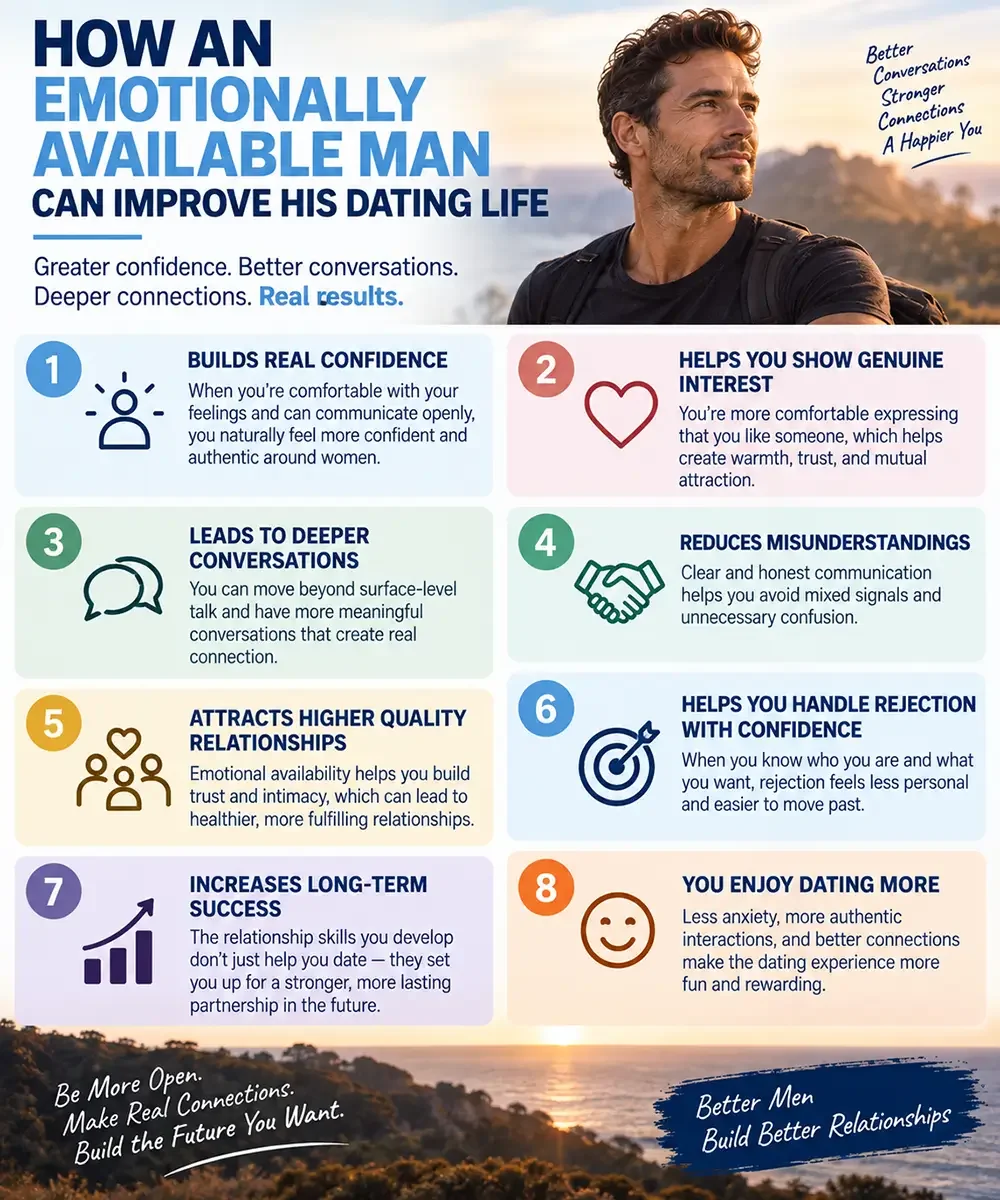
How These Skills Can Improve Your Dating Life
Learning to communicate more openly and becoming more comfortable with your emotions doesn’t mean every date will turn into a relationship, nor should it. Part of successful dating is figuring out who you connect with, what you’re looking for, and whether the person sitting across from you is actually a good match.
Developing these skills can make that process easier while also helping you build stronger connections when you do meet someone you’re genuinely interested in.
You Communicate Your Intentions More Clearly
For many women, a lot of frustration in dating comes from uncertainty. Does she know you’re interested? Does she know what you’re looking for? Are you both looking for the same type of relationship?
Being able to communicate your intentions doesn’t mean having a serious relationship conversation on the first date. It’s more about becoming more comfortable saying what you mean rather than expecting someone else to read between the lines. Remember, no one is a mind reader and what may be obvious to you isn’t always as clear to someone else.
Your Conversations Can Go Beyond the Surface
A good date shouldn't feel like a job interview. It should be a free-flowing opportunity to get to know the other person better. There’s nothing wrong with talking about work, hobbies, travel, or what you did over the weekend, but those topics only tell you so much about a person. As you become more comfortable with each other, conversations about experiences, values, ambitions, relationships, family, and the things that matter to you can help you find out whether there’s a connection beyond the physical attraction.
You Can Develop a Healthier Perspective on Rejection
Rejection is an unavoidable part of dating. You won’t connect with everyone you’re interested in, just as you won’t be interested in everyone who likes you. Attraction isn't something you can force, nor should you try to. If the other person isn't interested, that doesn't have to be a reflection of who you are or what you have to offer.
Being more aware of what you’re feeling can help you acknowledge the disappointment without immediately turning it into a judgment about yourself. Sometimes two people simply aren’t compatible, and realizing that can make it easier to move forward without allowing one dating experience to crush your confidence.
You Can Handle Disagreements More Constructively
A disagreement, or difference of opinion, doesn’t mean something is wrong with the relationship. Two people can care about each other and still have different opinions, expectations, or ways of looking at a situation. It’s healthy to have your own views and perspectives, as long as you can also respect and appreciate how the other person sees things, and vice versa.
Being able to listen, explain your perspective, and stay engaged without becoming defensive or withdrawing can make it easier to work through those differences. It can also help you recognize when a disagreement points to a larger incompatibility issue that shouldn’t be ignored.
You Give Someone the Chance to Really Know You
At some point, building a meaningful relationship requires letting someone see more than your accomplishments, career, interests, or the version of yourself you present on a first date. She also needs an opportunity to get to know your personality, values, sense of humor, experiences, quirks, and yes, even some of your imperfections.
You don’t need to reveal everything all at once. But gradually allowing someone to see more of who you are gives you both a chance to decide whether the connection is real and has the potential to become something more.
How Can a Man Become More Emotionally Available?
Becoming more emotionally available doesn’t require changing your personality or suddenly talking about everything you feel. It starts with becoming more aware of what’s going on internally and getting more comfortable communicating it when it matters.
Learn to Recognize What You’re Actually Feeling
It’s difficult to communicate an emotion when you’re not quite sure what you’re feeling in the first place. Instead of simply thinking, “I’m pissed,” take a moment to consider what might actually be underneath that reaction. Are you frustrated, disappointed, embarrassed, jealous, overwhelmed, hurt, or feeling rejected?
Being able to identify what you’re feeling can make it easier to understand why you’re reacting a certain way and communicate it without letting the emotion take over the conversation.
Get Comfortable Saying What You Mean
A lot of dating frustration comes from expecting the other person to figure out what you’re thinking. If you enjoyed spending time with someone, tell her. If something is bothering you, bring it up respectfully. If you’re unsure about where the relationship is going, ask.
Being direct doesn’t mean you need to share every thought that crosses your mind. It simply means communicating the things that matter rather than relying on hints, assumptions, or silence.
Listen Before Trying to Fix the Problem
Many men naturally move into problem-solving mode when someone they care about is upset. Sometimes that’s exactly what your partner wants. Other times, she may simply want you to listen and understand what she’s experiencing without trying to fix things.
If you’re not sure, there’s nothing wrong with asking, “Do you want my advice, or do you just want me to listen?” Listening to someone and acknowledging how they feel doesn’t necessarily mean you agree with their perspective. Sometimes the first step is simply making sure you understand what they’re trying to communicate.
The same applies when your partner is upset with you. Before explaining your side or becoming defensive, really listen and try to understand where she’s coming from. Asking “What made you feel that way?” doesn’t mean you automatically agree with her. It means you’re willing to hear her perspective before responding. And sometimes just saying, I hear you without engaging is the best policy.
Pay Attention to When You Pull Away
It can also be helpful to notice how you respond when a relationship starts getting more serious. Do you suddenly lose interest, withdraw, or start focusing on the other person’s flaws?
Sometimes you really have lost interest, and there’s nothing wrong with that. But if the same pattern keeps happening whenever someone gets close, it may be worth asking whether you’re losing attraction or perhaps you’re becoming uncomfortable with the vulnerability that comes with a deeper relationship. Taking a look inward can be helpful, especially when you’re willing to be honest with yourself about what you’re really feeling.
Open Up Gradually and Stay Engaged
You don’t have to start by sharing your deepest fears or most personal experiences. Opening up can be as simple as expressing appreciation, admitting when you’re nervous, talking about something meaningful to you, or acknowledging when something has hurt you. As trust develops, those conversations will naturally become more personal.
The same principle applies when conversations become difficult. You don’t have to resolve every disagreement immediately, and taking some time to collect your thoughts can be healthy. You might simply say, “I want to talk about this, but I need some time to think. Can we come back to it?”
The important distinction is between taking some space and avoiding the conversation altogether. Learning to come back, communicate, and work through uncomfortable moments is part of building a stronger connection with another person. These are opportunities that can really strengthen a partnership.
Healthy Relationships Still Need Boundaries
Being open and connected with someone doesn’t mean saying yes to everything, accepting disrespect, or giving up your independence. It also doesn’t mean relying on your partner to manage your feelings for you. A healthy relationship should have room for closeness while still allowing both people to maintain their own needs, opinions, independence, and personal boundaries.
An important part of building that kind of relationship is learning to communicate those boundaries clearly. You should be able to say, “I care about you, but I’m not comfortable with that,” or “I need some time to think about this,” without feeling like you’re pushing the other person away. Having healthy boundaries doesn’t prevent you from becoming closer to someone. When they’re communicated with honesty and respect, they can actually help both partners to better understand each other’s needs.
Building the Kind of Relationship You Actually Want
A lot of dating advice focuses on finding the right person, and of course that matters. But a lasting relationship also depends on what you bring to it and how the two of you learn to show up for each other over time.
If you want closeness, you have to be willing to let someone get close. If you want honesty, you need to communicate honestly yourself. And if you want a partner who listens, understands, and supports you, you also need to be willing to offer those things in return.
Ultimately, a fulfilling relationship is something two people build together. Being willing to communicate openly, understand each other’s perspectives, work through disagreements, and let yourself be known can create more trust and a deeper connection over time. It’s not about doing everything perfectly. It’s about finding someone you genuinely connect with and developing the relationship skills that can help that connection grow.
A Dating Coach Can Help Men Become More Emotionally Available
Dating coaching involves much more than learning how to approach women, improve your dating profile, or get more dates. A good dating coach can also help you take a closer look at how you show up when you actually connect with someone.
Sometimes it’s difficult to recognize patterns in your own dating life. You may overthink interactions, hold back because you’re afraid of rejection, become attached too quickly, pull away when someone starts getting closer, or have difficulty communicating when something really matters to you. A qualified coach can provide an outside perspective and help you understand where those patterns may be getting in the way.
From there, you can work on practical skills such as communicating more clearly, becoming comfortable with appropriate vulnerability, setting healthy boundaries, navigating difficult conversations, handling rejection, and better understanding your own emotional responses. You can also become more intentional about who you date and what you’re actually looking for in a relationship.
Ultimately, the goal isn’t to change who you are or teach you to behave a certain way around women. It’s to help you better understand yourself, communicate more confidently, and develop the relationship skills that can make dating feel more natural and productive. Finding the right person still matters. But when you're more comfortable expressing what you want, communicating openly, letting someone get to know you, and staying engaged as a relationship develops, you give yourself a better opportunity to build a connection that can grow into a successful and fulfilling relationship.
"Women Love Emotionally Available Men"
Build Stronger Connections With Women

Emotionally Available Men - FAQs
What does a man That is emotionally available Look Like?
It generally means he’s comfortable recognizing what he’s feeling and communicating the things that matter to him. He’s willing to listen without interrupting, consider her perspective, and gradually let her get to know him on a more personal level as trust develops.
That doesn’t mean he needs to talk about his emotions constantly or share every thought that crosses his mind. It’s more about being willing to open up when it matters, express what he wants and needs, and stay engaged when conversations become more personal or difficult. Over time, that kind of openness can make it easier for both people to understand each other and build a deeper connection.
How can you tell if you’re emotionally unavailable in dating?
Look for recurring patterns rather than one particular behavior. If you’re regularly pulling away when someone gets too close, avoiding personal conversations, shutting down during conflict or disagreements, or becoming uncomfortable with a relationship getting more serious may be signs worth paying attention to. Remember, it’s important to focus on the patterns, not a single event.
Why do some men have trouble opening up in relationships?
There can be a lot of reasons for this. Some men grew up where emotions weren’t discussed, or even discouraged, while others may have learned to handle problems on their own. Certain other factors can weigh in as well such as previous relationships that were difficult, rejection, betrayal, or going through heartbreak can also make someone much more cautious about opening up again.
How do I show a woman I’m really interested in her?
You can show your interest through relatively simple behaviors, such as: asking questions about her, listening to her answers, following through on plans you make, communicating consistently and openly, expressing your appreciation, and telling her when you enjoy spending time together. You don’t need elaborate gestures or gifts to make your intentions clearer. A man who listens and focuses on her, rather than himself, shows that he is genuinely interested.
Why is listening so important in a relationship?
Sometimes the best thing you can do is simply listen and give your partner a chance to explain how she’s feeling. You don’t have to agree with everything she says, but taking the time to understand where she’s coming from can prevent a lot of unnecessary misunderstandings and make it easier to talk things through together.
How can I get better at talking about my feelings?
Start by paying attention to what you’re really feeling in the moment. You may think you’re simply angry, but there could be something else underneath it. Maybe you’re frustrated, disappointed, embarrassed, hurt, worried, or feeling rejected. Taking a moment to figure out what’s actually bothering you can make it much easier to put those feelings into words and explain them to someone else.
How can I communicate better during a disagreement?
When you disagree, try to understand where the other person is coming from before jumping in to prove your point. Listen to what she has to say, explain your own perspective, and keep the conversation respectful. If things start getting heated, there’s nothing wrong with taking some time to cool down and collect your thoughts. Just make sure you’re willing to come back and finish the conversation rather than using the break to avoid it altogether.
Is needing space in a relationship a sign of emotional unavailability?
Not necessarily. Sometimes you just need a little time to yourself or a chance to process a difficult conversation before coming back to it, and that can be perfectly healthy. It becomes more of a concern when taking space turns into regularly pulling away or avoiding conversations and relationship issues that eventually need to be addressed.